
Pad printing has been a proven solution for decorating and marking three-dimensional products for decades. But as manufacturers demand greater flexibility, faster changeovers, variable data, and increasingly digital workflows, industrial inkjet printing is changing the way products are decorated.
So, is inkjet printing replacing pad printing? Not necessarily.
For printing professionals, the better question is: When should you use pad printing, when should you use inkjet printing, and when does a hybrid approach make the most sense?
Both technologies have advantages. The right choice depends on the substrate, part geometry, image requirements, production volume, durability expectations, and how much flexibility your production line needs.
This guide compares pad printing vs. inkjet printing and explores what the move from traditional to digital printing really means for modern manufacturing.
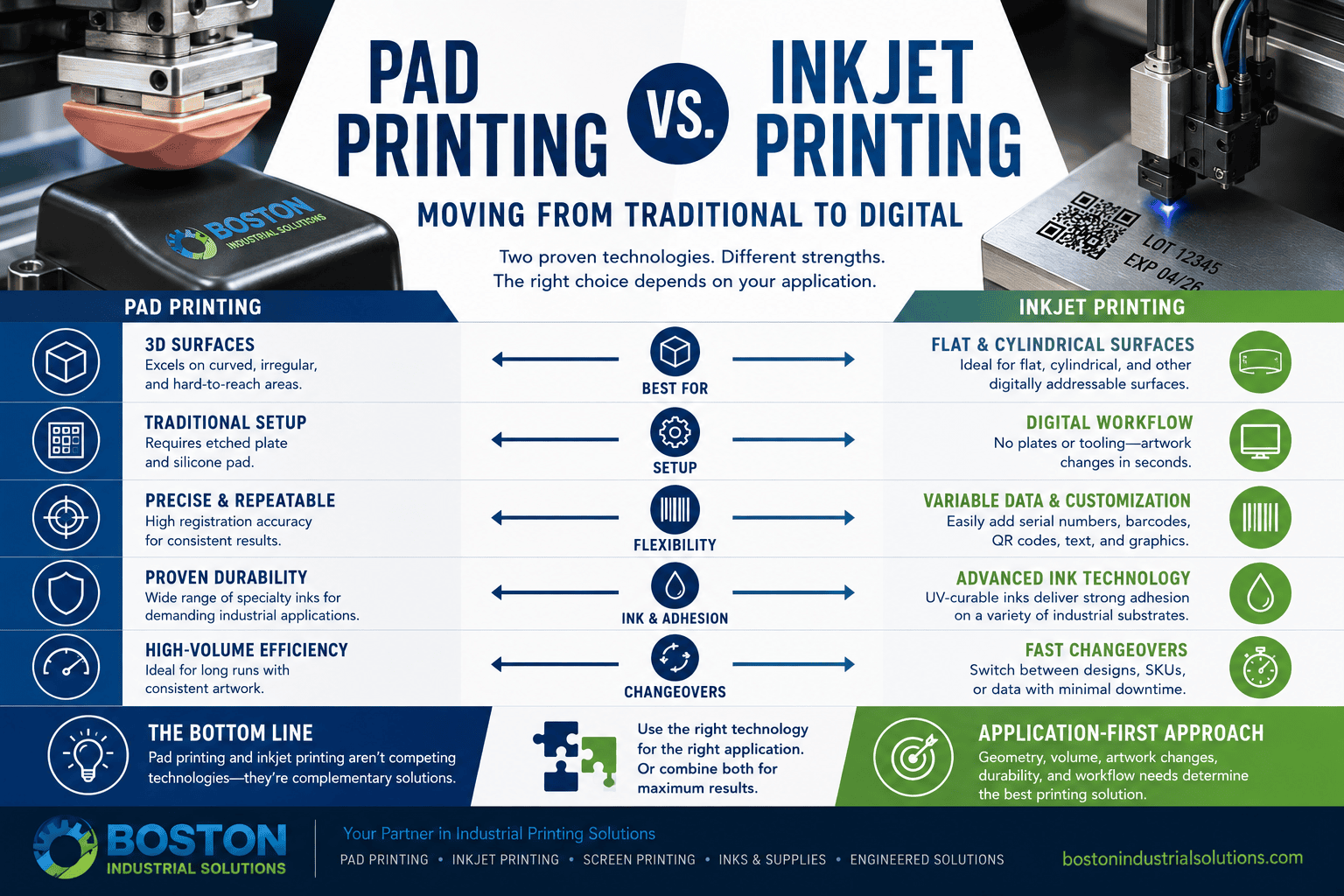
Pad Printing vs. Inkjet Printing at a Glance
Factor |
Pad Printing |
Industrial Inkjet Printing |
| Printing method | Indirect transfer using a silicone pad and etched plate | Direct, non-contact digital printing |
| Best for | 3D, curved, irregular, and hard-to-reach surfaces | Flat, cylindrical, and other digitally addressable surfaces |
| Artwork changes | Requires plate/artwork changes | Digital artwork can be changed quickly |
| Variable data | Limited | Excellent |
| Short runs | Can be economical depending on setup | Particularly well suited |
| High-volume production | Excellent for established designs | Excellent when digital flexibility is valuable |
| Multiple colors | Available, with process and setup considerations | Digital color workflows can simplify design changes |
| Customization | More setup required | Highly flexible |
| Setup | Mechanical and plate-based | Primarily digital |
| Contact with substrate | Yes | No |
| Complex 3D shapes | Major strength | Depends on printer and application |
| Digital workflow | Limited | Core capability |
Where Pad Printing Excels
Pad printing remains an excellent choice when:
- The product has a complex or irregular geometry.
- The image needs to conform to a curved surface.
- Production volumes are high and the artwork remains consistent.
- Extremely precise image placement is required.
- A proven, repeatable production process is more important than frequent customization.
- The application requires specialized inks engineered for a particular substrate.
- Existing pad printing equipment and tooling already support the production requirement.
For many industrial applications, these advantages are difficult to replace with a digital process.
Where Inkjet Printing Excels
The artwork is controlled digitally, allowing manufacturers to change images, graphics, text, barcodes, serial numbers, or other information without creating a new printing plate.
This makes industrial inkjet especially attractive for applications where customization and rapid changeovers are important.
Industrial inkjet becomes particularly attractive when manufacturers need:
- Short production runs
- Rapid artwork changes
- Variable data
- Serialization
- Barcodes and QR codes
- Personalized graphics
- Multiple SKUs
- On-demand printing
- Reduced dependence on physical plates
- Integration with digital production workflows
In other words, inkjet turns printing from a fixed process into a programmable process.
Pad Printing vs. Inkjet: The Key Differences
-
Traditional Tooling vs. Digital Artwork
Pad printing typically requires a physical cliché containing the image to be printed. Changing the artwork can therefore involve creating new tooling or plates. With inkjet printing, the image is sent digitally to the printer, making artwork changes much faster and easier.
Winner for digital flexibility: Inkjet
-
Complex Shapes vs. Non-Contact Printing
Because the silicone pad physically conforms to the product surface, pad printing can decorate many three-dimensional, curved, recessed, and irregular parts. An inkjet printer’s printhead configuration, working distance, substrate movement, surface geometry, ink characteristics, and curing system all influence what is practical.
Winner for complex 3D surfaces: Pad printing
-
Short Runs and Customization
Traditional pad printing can be extremely efficient once the process is set up and optimized. However, frequent artwork changes can introduce additional setup requirements. The operator can change the artwork design digitally when inkjet printing. This is particularly useful for promotional products, limited editions, multiple product variations, and serialized components.
Winner for customization: Inkjet
-
Production Speed
Pad printing can be exceptionally productive in high-volume applications, particularly when the same image is being printed repeatedly and the equipment is properly automated.
Inkjet can reduce setup and changeover time, which may be more important than raw print-cycle speed in applications with frequent product changes.
-
Print Quality and Resolution
Both technologies can produce high-quality industrial graphics, but they approach image reproduction differently.
Pad printing is well known for precise image transfer and its ability to reproduce graphics on difficult geometries.
Digital inkjet provides excellent control over digitally generated graphics and can be particularly attractive for detailed artwork, variable information, gradients, photographic images, and designs that change frequently.
-
Variable Data and Serialization
This is one category where digital inkjet has a clear advantage.
Pad printing is fundamentally designed around transferring a predefined image. Inkjet printing is digitally controlled, making it much easier to produce a different image or data set from one part to the next.
That opens the door to:
- Serial numbers
- QR codes
- Barcodes
- Product IDs
- Lot codes
- Dates
- Personalized graphics
- Regulatory markings
- Variable text
-
Which Technology Is More Sustainable?
Digital printing can reduce the need for physical plates and make short-run production more efficient. The most sustainable technology is often the one that minimizes total material, energy, and production waste for the specific application.
The Future May Be Hybrid: Pad Printing + Inkjet
Modern manufacturers do not necessarily need to choose one technology for every application. A production facility might use pad printing for high-volume graphics on complex components while using inkjet for variable data, customization, short-run products, or digitally generated artwork.
This approach allows manufacturers to match the printing technology to the application instead of forcing every product through the same process. For printing professionals, that means the future is about building the right combination of technologies.
Explore our pad printing machines and UV digital printers.